
Kevin H Gordon
MFA Thesis
MFA Thesis
© 2019 - Kevin H Gordon
Designing for Deaf Accessibility in VR
Research
HISTORY OF ACCESSIBILITY
Accessibility in Entertainment - Subtitles
No discussion on the impact and reach of accessibility products can begin without first discussing the many organizations responsible for making these products available and popularized in the mainstream. The hard work of various different organizations, associations and companies have created a space for issues to be addressed and solutions to flourish, without their support there would be no accessibility. A critical example of organizations working to improve accessibility options is found everyday in the closed caption features found in traditional and online media. According to the National Association for the Deaf, up until the late 1990s it wasn’t a requirement for media to have closed captioning for any dialogue in the United States [6]. That all changed with the passage of the Telecommunications Act of 1996, which required all media to be closed captioned and translated before being aired in any medium. Since the passage of this act, many organizations such as BBC and Netflix [6] have released various guidelines that govern how closed captioning should be displayed when consuming media.
As a general rule for closed captioning, the text should be large enough for viewers to read and text content should not exceed 32-36 characters per line. There are addition specification for font type, size, and background color that all serve to increase the readability of captions across multiple display types.These guidelines not only applies to traditional display media, like television and film, but can also apply to games when making captioning for spoken dialogue.
No discussion on the impact and reach of accessibility products can begin without first discussing the many organizations responsible for making these products available and popularized in the mainstream. The hard work of various different organizations, associations and companies have created a space for issues to be addressed and solutions to flourish, without their support there would be no accessibility. A critical example of organizations working to improve accessibility options is found everyday in the closed caption features found in traditional and online media. According to the National Association for the Deaf, up until the late 1990s it wasn’t a requirement for media to have closed captioning for any dialogue in the United States [6]. That all changed with the passage of the Telecommunications Act of 1996, which required all media to be closed captioned and translated before being aired in any medium. Since the passage of this act, many organizations such as BBC and Netflix [6] have released various guidelines that govern how closed captioning should be displayed when consuming media.
As a general rule for closed captioning, the text should be large enough for viewers to read and text content should not exceed 32-36 characters per line. There are addition specification for font type, size, and background color that all serve to increase the readability of captions across multiple display types.These guidelines not only applies to traditional display media, like television and film, but can also apply to games when making captioning for spoken dialogue.
State of Accessibility
The current state of accessibility in the Video Game and VR industry has been on rather shaky grounds for the past few years. For all of the strides that games like Marvel's Spider Man made in making games inclusive, there's always games like Spyro the Reignited Trilogy that falters in providing basic accessibility solutions. In the case of Spyro the Reignited Trilogy, the game got a great deal of heat for failing to include subtitles in the game for the first 4 months, closing the game off to an entire community of players. While that situation is indeed bad, the issue with accessibility doesn't always have to fall to an issue of games having subtitles vs. not having them. Even games with subtitles can create unintentional barriers for the Deaf/HoH community, as developers can sometimes make interesting design decision that often only make their subtitles that much harder to follow.
The issue of accessibility for the Deaf/HoH is even more prevalent in the realm of Virtual Reality, as developers are still struggling to correctly gauge how subtitles and closed captioning will even work on the platform. In all of my research, I don't think any article summaries the issue of subtitles in VR than Ian Hamilton did in the Gamasutra article, "How to Do Subtitles Well, Basic and Good Practice". In that article he breaks down many of the issues and concerns regarding subtitles in gaming as a whole and had a very pointed observation on the issue of subtitling/captioning in VR. More specific he notes, "There is a really significant issue with subtitling / captioning in VR - the general lack it.". That simple note, however brief, is largely indicative of the current situation in VR gaming right now.
One of the main issues when developing accessible products in VR is the issues of the Vergence-Accommodation Conflict. The medium.com articles on the Vergence-Accommodation Conflict goes into this issues in much more detail; but in a nutshell the issue of Vergence-Accommodation has to deal with how your eyes focus on information in VR. It would appear that developers have found it difficult in figuring out ways to allow end-users to look at and adjust to new text without causing to much strain on the eyes.
The current state of accessibility in the Video Game and VR industry has been on rather shaky grounds for the past few years. For all of the strides that games like Marvel's Spider Man made in making games inclusive, there's always games like Spyro the Reignited Trilogy that falters in providing basic accessibility solutions. In the case of Spyro the Reignited Trilogy, the game got a great deal of heat for failing to include subtitles in the game for the first 4 months, closing the game off to an entire community of players. While that situation is indeed bad, the issue with accessibility doesn't always have to fall to an issue of games having subtitles vs. not having them. Even games with subtitles can create unintentional barriers for the Deaf/HoH community, as developers can sometimes make interesting design decision that often only make their subtitles that much harder to follow.
The issue of accessibility for the Deaf/HoH is even more prevalent in the realm of Virtual Reality, as developers are still struggling to correctly gauge how subtitles and closed captioning will even work on the platform. In all of my research, I don't think any article summaries the issue of subtitles in VR than Ian Hamilton did in the Gamasutra article, "How to Do Subtitles Well, Basic and Good Practice". In that article he breaks down many of the issues and concerns regarding subtitles in gaming as a whole and had a very pointed observation on the issue of subtitling/captioning in VR. More specific he notes, "There is a really significant issue with subtitling / captioning in VR - the general lack it.". That simple note, however brief, is largely indicative of the current situation in VR gaming right now.
One of the main issues when developing accessible products in VR is the issues of the Vergence-Accommodation Conflict. The medium.com articles on the Vergence-Accommodation Conflict goes into this issues in much more detail; but in a nutshell the issue of Vergence-Accommodation has to deal with how your eyes focus on information in VR. It would appear that developers have found it difficult in figuring out ways to allow end-users to look at and adjust to new text without causing to much strain on the eyes.
RESEARCH DATA
At a glance
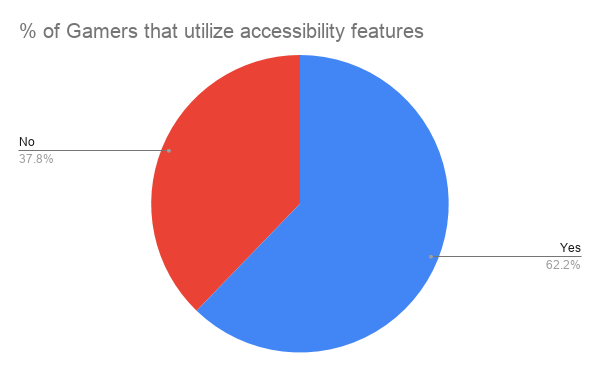
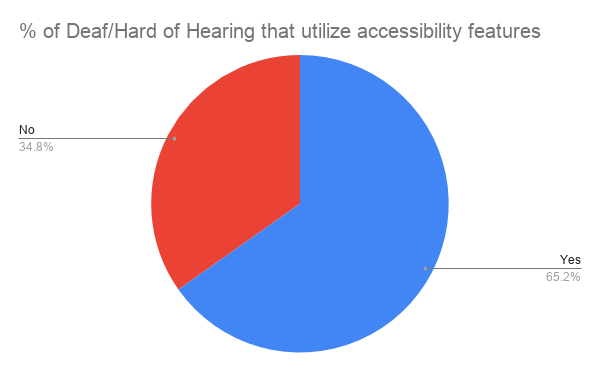
The data reflects that 70% of people utilize subtitles when playing games, while 30% elects not to turn them on. From anaylzing data from the first round of surveys it's found that the overwhelming majority of people, both hearing and deaf, utilize subtitles.
By the numbers
A look at all of the data in full. Link to view a pdf of that data also linked below.
Click here for full data
What it all means?
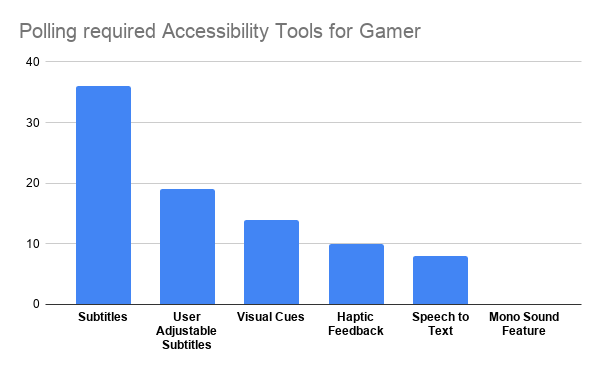
From taking a look at the data, it is clear that subtitles and haptic functions are a must-having functionalities if games are to become more inclusive. This is the primary reason why the first solution that's being tackled in this projects is User Adjustable Subtitle support in VR. Other solutions that will be tackled, based on the data, are solutions for Haptic Feedback and Visual Icons.
Survey 1
Accessibility in Gaming
Accessibility in Gaming
Focus Group
Feedback from group study
Feedback from group study
Survey 3
*Upcoming*
*Upcoming*
The data reflects that 70% of people utilize subtitles when playing games, while 30% elects not to turn them on. From anaylzing data from the first round of surveys it's found that the overwhelming majority of people, both hearing and deaf, utilize subtitles.
A look at all of the data in full. Link to view a pdf of that data also linked below.
Click here for full data
From taking a look at the data, it is clear that subtitles and haptic functions are a must-having functionalities if games are to become more inclusive. This is the primary reason why the first solution that's being tackled in this projects is User Adjustable Subtitle support in VR. Other solutions that will be tackled, based on the data, are solutions for Haptic Feedback and Visual Icons.
BIBILOGRAPHY
Scholarly Research
Articles
Articles
- Lifeprint – Video Games and the Deaf Community
- Digital Trends – The Deaf Gamers Making Gaming More Accessible
- It’s Designers Who Can Make Gaming More Accessible for People with Disabilities
- Hearing Like Me – Fortnite Accessibility for Deaf Gamers
- Activision Addresses why Spyro the Reignited Trilogy has no Subtitles